Potsdam Institute for Climate Impact Research (PIK)
Interdisciplinary Center for Dynamics of Complex Systems (University of Potsdam)
TOCSY - Toolboxes for Complex Systems
PIK/ Antique/ Blue
Home Home | ACE - Nonlinear Regression Analysis ACE | Adaptive Filtering Procedure Adaptive Filtering | COPRA - Constructing Proxy Records From Age Models COPRA | Cross Recurrence Plot Toolbox CRP Toolbox | Commandline Recurrence Plots Commandline RPs | Identification of Coupling Direction Coupling Direction | Dynamical Invariants by Recurrence Plots K2 | NEXCF - Correlation for Time Series with Arbitrary (Non-Equidistant) Time Scales NEXCF | DSProlog DSProlog | pyunicorn ‐ UNIfied COmplex Network and Recurrence aNalysis toolbox pyunicorn | System Identification Tool System Identification | Time Series Graph and Momentary Information Transfer Estimation Tigramite | Wavelet and Coherence Analysis SOWAS  

System Identification Tool

Version 1.6.1 (R9.3b), last mod. 25-Feb-2008 12:34:15


General Notes

The system identification tool (SIT) for MATLAB® contains the nonlinear extension of the Kalman filter (unscented Kalman filter). It is a collection of M-files implementing several numerical schemes (state estimation, simultaneous state and parameter estimation) within the framework of state space filtering. Furthermore, a graphical user interface is provided. It includes a comfortable editing environment for the design of the models to be fitted.

Requires Matlab 5.3 or higher.


Usage and Notation

State space models considered here are restricted to the continuous-discrete form:

d
—
dt
 x (t)  =  f(x, p, ε),
 y(kΔt)  =  h(x(kΔt)) + η(kΔt),

where
y - observation vector (i.e. multivariate data point),
x - state vector,
p - parameter vector,
η - observational noise (vector),
ε - dynamical noise (vector),
kΔt - discrete sampling time (k=0,1,...),
Δt - sampling rate.

(Currently, the case of dynamical noise is not implemented yet.)

sit calls the main programme for the system identification. First a data set has to be imported from a file or generated by using a predefined model. Afterwards a model can be fitted. Model quations can be applied within a comfortable euqation editor. Calling the sitdemo gives an imagination of the procedure of system identification.

The input notation for the equation editor corresponds to the Matlab syntax

y(1), y(2), ... - components of the observation vector,
x(1), x(2), ... - components of the state vector,
p(1), p(2), ... - components of the parameter vector,
\eta(1), \eta(2), ... - components of the observational noise,
\epsilon(1), \epsilon(2), ... - components of the dynamical noise.

This tool stores the applied data in a native format which is based on a structure array and stored in the Matlab format (MAT). For more information call help sit.

Data stored in another format as MAT or plain ASCII can also be imported.

Estimation results are stored as a MAT-file in the results folder with a sub-prefix _filter or _filter_state and the current time of estimation. It contains a structure L, whose fields contain the data and the parameters of the model system and the estimation. The estimated states and the estimated parameters are in the field XEST.

Sessions and models can be saved and loaded. The extension of these files is EQU. Furthermore, the model equations can be exported to an M-file in order to use the model with standard Matlab ODE solvers. Models given by ODE M-files can be imported into the SIT equation editor, too.


Demos and Examplary Data Set

sitdemo or sitdemo lorenz calls a demo using the Lorenz system with two observations.

sitdemo circuit calls a demo where the fitting of a model to experimental data taken from a circuit in chaotic regime ist shown. As data the circuit.dat is used and for the model this that is contained in the circuit.equ session.

lorenz.equ A session file for the System Identification Tool (SIT). It contains a model of the Lorenz system with two observations and observational noise.
duffing.equ A session file for the System Identification Tool (SIT). It contains a model of the Duffing system with one observation and observational noise.
circuit.equ A session file for the System Identification Tool (SIT). It contains a model of 3 states, 9 parameters and observational noise, which can be fitted to experimental data of an electric circuit in chaotic regime, which is given by the file circuit.dat. The model fitted here is due to Timmer et al., 2000.
circuit.dat   This data set contains potential measurements of an electrical circuit in chaotic regime. The data are provided by the benchmark of the predictability contest; technical details may be found at y2k.maths.ox.ac.uk/systems/egb.html.

Screenshots

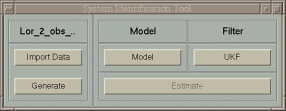
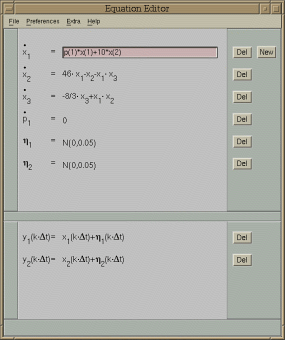
The major control window (top) and the equation editor (bottom).

The SIT main window.
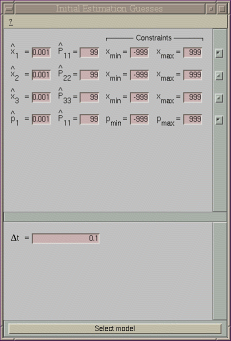
The equation editor. The parameter/ initial guesses editor.

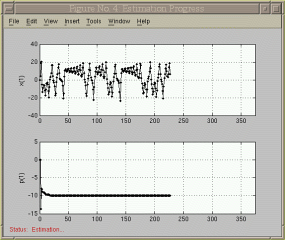
The estimation progress can be followed online.

The progress window.

References

  1. Sitz, A., Schwarz, U., Kurths, J., Voss, H. U.: Estimation of parameters and unobserved components for nonlinear systems from noisy time series, Phys. Rev. E, 66, 2002, 016210, doi:10.1103/PhysRevE.66.016210.

  2. Sitz, A., Kurths, J., Voss, H. U.: Identification of nonlinear spatiotemporal systems via partitioned filtering, Phys. Rev. E, 68, 2003, 016202, doi:10.1103/PhysRevE.68.016202.

  3. Julier, S. J., Uhlmann, J. K.: A New Extension of the Kalman Filter to Nonlinear Systems, in: The Proceedings of AeroSense: The 11th International Symposium on Aerospace/Defense Sensing, Simulation and Controls, Orlando FL, USA, 1997, SPIE, Multi Sensor Fusion, Tracking and Resource Management II.

  4. Timmer, J., Rust, H., Horbelt, W., Voss, H. U.: Parametric, nonparametric and parametric modeling of a chaotic circuit time series, Phys. Lett. A, 274, 2000, 123-134, doi:10.1016/S0375-9601(00)00548-X.


Download

Download this Toolbox via ID:

 ID:  password:     

If you have problems with download, first check if you use a proxy connection or a firewall. Both may affect the downloaded file resulting in an error message during the installation in Matlab.


Request an ID:

Name:
eMail:
Institution (incl. address and country):
Research field:
Purpose of application SIT:

Privacy Policy

The data you have submitted will be used for the purpose of statistical review of our toolbox. We will neither give the personal information to third parties nor use it for any other purpose.


User Agreement

By downloading the SIT toolbox you agree with the following points:

  1. The toolbox is provided without any warranty or conditions of any kind.

  2. We assume no responsibility for errors or omissions in the results and interpretations following from application the toolbox.

  3. You commit to cite the SIT toolbox in your reports or publications if used.


Copyright

Copyright (c) 2002-2003 Nonlinear Dynamics Group
Potsdam University, Germany
http://www.agnld.uni-potsdam.de
André Sitz, Norbert Marwan, Christian Hoennicke


Author

André Sitz


Creative Commons License

© 2004-2013 SOME RIGHTS RESERVED
University of Potsdam, Interdisciplinary Center for Dynamics of Complex Systems, Germany
Potsdam Institute for Climate Impact Research, Transdisciplinary Concepts and Methods, Germany

This work is licensed under a Creative Commons Attribution-NonCommercial-NoDerivs 2.0 Germany License.

Please respect the copyrights! The content is protected by the Creative Commons License. If you use the provided programmes, text or figures, you have to refer to the given publications and this web site (tocsy.pik-potsdam.de) as well.

@MEMBER OF PROJECT HONEY POT
Spam Harvester Protection Network
provided by Unspam